Quick answer
The automations every business should set up, in order, are: capturing every lead into your CRM, instant lead follow-up, appointment reminders, invoicing and payment reminders, client onboarding, internal alerts, and simple reporting. Build the ones tied to revenue and daily repetition first, because they pay back fastest. You don't need to automate everything at once. A handful of reliable automations closes the leaks and clears the busywork that quietly cost you time and sales.
Most business owners lose hours every week to work a computer should be doing. Copying leads from a form into a spreadsheet. Sending the same reminder for the third time. Chasing an invoice that went quiet. Updating one tool because another one changed. None of it grows the business, and all of it has to happen anyway. That is what business automation removes.
The problem is that “automate your business” is advice with no edges. It tells you nothing about what to build or in what order. This guide fixes that. Below are the automations that pay for themselves fastest, what each one actually does, the tools that build them, and the sequence that gets you a return in weeks rather than months. AryzeTech builds, grows and automates for clients as one connected team on a flat monthly retainer, so these are the same automations we wire up every week, not a theory.
Key takeaways
- Speed and consistency, not headcount, are what automation buys you: leads answered in seconds and follow-ups that never get forgotten.
- Start with the automations tied to revenue and daily repetition (lead capture and follow-up). They pay back in weeks, not quarters.
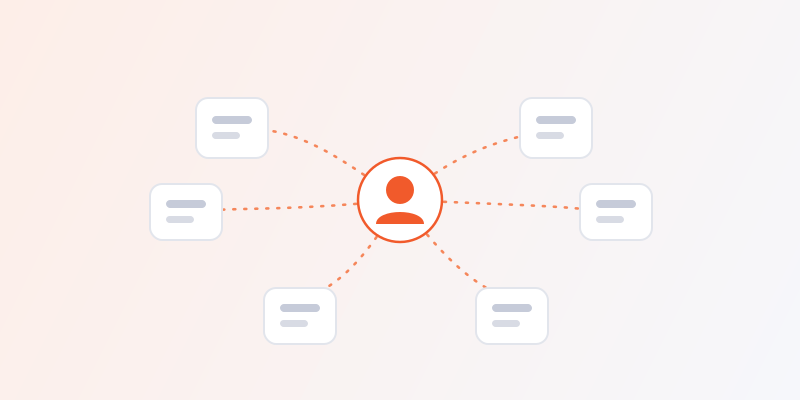
- Your CRM is the hub. Almost every worthwhile automation either fills it or fires off the back of it.
- The tool (Zapier, Make, n8n or your CRM’s native automation) matters less than making the automation reliable. A silent failure is worse than no automation.
- Automating a broken process just makes the mess faster. Fix the steps first, then automate the clean version.
- Every automation needs a named owner who gets alerted when it breaks, or it will fail quietly and cost you leads.
What business automation actually is
Business automation is wiring your tools together so a trigger in one makes something happen in another, without a person in the middle. A lead submits your website form (the trigger), and the automation creates a CRM record, sends them a text, books them a reminder, and pings your sales channel (the actions). No copy-paste, no “I’ll get to it,” no forgetting.
It helps to separate two words people use interchangeably. An integration simply connects two tools so they can pass data. An automation uses that connection to do useful work on a rule you set. Integrations are the plumbing, and automations are the water actually running through the pipes and doing a job. You want automations, and integrations are what make them possible.
Automation is also not the same as artificial intelligence, though the two increasingly work together. Most of the highest-value automations in a business are simple, deterministic rules: if this, then that, every time. They are boring, and boring is exactly what you want from something that runs your invoicing. AI can sit on top later (drafting a reply, sorting a message, summarising a call), but the workhorses below are plain, reliable logic.
The automations every business should set up
You do not need hundreds of automations. You need a handful that cover the moments where money and time leak fastest: catching a lead, responding to it, keeping the appointment, getting paid, onboarding the customer, and keeping your team and your numbers in sync. Here is the core set, then a breakdown of each.
| Automation | What it does | Typical tools | Why it matters |
|---|---|---|---|
| Lead capture into a CRM | Sends every lead from every source into one CRM, tagged and ready to work | HubSpot, Make, Zapier | Stops leads leaking and kills manual data entry |
| Instant lead follow-up | Replies to a new lead in seconds with a text, email or booking link | Zapier, Make, CRM workflows | Speed-to-lead wins deals; slow replies lose them |
| Appointment and booking reminders | Sends timed reminders before a call or appointment | Calendly, HubSpot, Make | Cuts no-shows, which are pure lost revenue |
| Invoicing and payment reminders | Issues invoices and nudges politely until paid | Stripe, QuickBooks, Make | Gets you paid faster and protects cash flow |
| Client and customer onboarding | Fires welcome messages, next steps and intake forms automatically | HubSpot, email tools, Make | Consistent first impression, less dropped-ball risk |
| Internal alerts and notifications | Pings the team the moment something important happens | Slack, email, Make | Everyone knows without asking or checking |
| Reporting and dashboards | Pulls numbers into a live dashboard or scheduled summary | Looker Studio, Sheets, CRM | Decisions on current data, not month-old guesses |
| Syncing data between tools | Keeps records matched across your whole stack automatically | Make, Zapier, n8n | One source of truth, no contradictory copies |
Capture every lead into your CRM
This is the foundation, so build it first. Every lead, from your website form, your ads, your DMs, your inbox, your live chat, should land in one CRM automatically, tagged with where it came from and ready to work. Doing this by hand is where leads quietly slip through the cracks and where hours disappear into copy-paste. Wire it once and your pipeline fills itself.
This is exactly where a well-configured HubSpot CRM earns its keep, because it becomes the single hub the rest of these automations fire from. If you are weighing the setup cost against doing it piecemeal, we broke the numbers down in what a HubSpot CRM setup costs.
Instant lead follow-up
The single highest-return automation there is. Leads go cold fast, and the business that replies first usually wins the deal. An automation that acknowledges every new lead the moment it arrives (a text, an email, a link to book a time) means you never lose to a competitor who was simply faster to respond. It gives you a response speed no human rota can match, at 2pm or 2am.
This pairs with a proper set of email flows every business needs, so the instant reply is the first touch in a sequence that keeps warming the lead while your team catches up. This one automation often pays for every other on this list by itself.
Appointment and booking reminders
No-shows are revenue you already earned and then lost. For any business that runs on calls, consultations or appointments, an automated reminder sequence (a message the day before, another an hour before, each with an easy reschedule link) reduces them sharply. Set it once and it protects your calendar for good, without anyone remembering to send a single reminder.
Invoicing and payment reminders
Chasing money is awkward, easy to forget, and it hits cash flow directly. Automate it: issue the invoice on the trigger you choose, then send polite, scheduled nudges until it is paid, and a thank-you once it clears. You get paid faster, late payers get chased consistently instead of whenever someone remembers, and nobody on your team has to write the uncomfortable “just following up” note again.
Client and customer onboarding
The moment someone becomes a customer is when a great first impression matters most and when balls get dropped. An onboarding automation sends the welcome message, spells out what happens next, and collects the forms or details you need, the same polished way every time. It makes new clients feel looked after and saves your team from rebuilding the process from memory on every deal. A review request timed for just after a completed job or purchase fits naturally at the end of this same flow, so your reputation compounds without anyone remembering to ask.
Internal alerts and notifications
Your team should not have to refresh five dashboards to know what is going on. Route the events that matter (a high-value lead came in, a payment failed, a big deal closed, a support ticket has gone quiet) straight into the tool they already live in, usually Slack or email. Less “any update on that?” and more everyone simply knowing, in real time, without a meeting.
Reporting and dashboards
Most owners make decisions on numbers that are weeks old because pulling a report is a chore. Automate it. Have your tools push their figures into one live dashboard, plus a short recurring summary in your inbox or team channel every Monday. You get to steer on current reality instead of last month’s guess, and the weekly “can someone pull the numbers?” scramble disappears.
Syncing data between your tools
This one sits underneath the other seven. When a contact updates their details, a deal changes stage, or a customer cancels, that change should ripple to every tool that needs to know, automatically. Without it, your CRM says one thing, your email tool another, and your invoicing a third, and someone spends Friday afternoon reconciling them. Keeping records in sync gives you one source of truth, so the automations above always fire on correct data. It is unglamorous, and it is what stops the whole system drifting out of alignment.
The tools to build them
Four options cover almost everything, and the right one depends on your volume, your budget and your team’s technical comfort. The full comparison lives in Make vs Zapier vs n8n, but here is the short version.
- Zapier is the easiest to start with and connects to the most apps. A non-technical person can build a useful automation the same afternoon. It charges per task, so it gets expensive once you are running multi-step automations at volume.
- Make gives you a visual builder with real logic, branching and loops at a much lower price per action. It carries a small learning curve, and for most growing businesses it is the value sweet spot.
- n8n is the most powerful and the cheapest at scale, especially self-hosted, and it keeps your data on your own infrastructure. The trade-off is that it is the most technical to run.
- Native CRM automation is the one people forget. Tools like HubSpot have capable built-in workflows, so a lot of your lead, follow-up and onboarding logic can live inside the CRM itself, with no extra tool to pay for or maintain.
The honest meta-point: the tool matters far less than making the automation reliable. Many businesses run more than one, using the CRM’s native workflows and Zapier for quick wins, then Make or n8n for the heavy lifting.
Where to start (highest-ROI first)
Do not try to automate everything at once. Build in the order that returns money fastest.
- Lead capture and instant follow-up first. These touch revenue directly and run many times a day, so they pay back in weeks. Get every lead into the CRM and answered in seconds before anything else.
- Then the money and calendar protectors. Invoicing and payment reminders to speed up cash flow, and appointment reminders to stop no-shows.
- Then the experience and visibility layer. Onboarding, internal alerts, reporting, and the data syncing that keeps it all honest.
The principle is simple: automate the money-movers and the daily time-sinks first, get fancy later. One reliable automation earning its keep beats ten half-built ones nobody trusts.
Common mistakes
Automating a broken process
Automation makes a process faster, not better. If your intake is a tangle of unclear steps and missing information, automating it just produces the same mess at speed, now harder to spot because a human is no longer in the loop. Fix and simplify the process on paper first, then automate the clean version.
No error handling
An automation that fails silently is the dangerous kind. If your lead-capture breaks and nobody is told, you can lose leads for a week before anyone notices the pipeline went quiet. Every important automation needs error handling: a retry, a fallback, and an alert to a human the moment something does not go through. This is the difference between a hobby automation and one you can run a business on.
No owner
Every automation needs a named person responsible for it, someone who gets the alert when it breaks and knows how to fix it. Automations are not “set and forget.” Apps change their connections, credentials expire, edge cases appear. Without an owner, small breakages accumulate quietly until the system you relied on is half-dead and nobody noticed. This is the single biggest reason do-it-yourself automations rot.
An illustrative scenario
Picture a small consultancy taking twenty leads a week from a website form and a couple of ad campaigns. Before automation, a team member copies each lead into a spreadsheet when they get a minute, replies to most of them within a few hours, remembers to send reminders when they can, and invoices at month end. Leads slip, some replies land too late, a few appointments no-show, and a couple of invoices go unpaid longer than they should.
Now wire it up. Every lead lands in the CRM the instant it is submitted, tagged by source. Each one gets a text and email within seconds, plus a booking link. The day before a call, a reminder goes out automatically, cutting no-shows. When a client signs, an onboarding sequence handles the welcome and the intake forms. Invoices issue on completion and chase themselves until paid. The team sees each new lead in Slack in real time, and a Monday dashboard shows the week’s numbers without anyone pulling a report.
If those twenty leads previously converted at, say, twelve percent, and faster response plus fewer no-shows lifts that even a few points, the automations pay for themselves many times over from won work alone, before you count the hours saved. (Illustrative, not a quote: your numbers depend on your business.)
The bottom line
You do not need to automate everything. You need the handful that close the leaks: capture every lead into your CRM, follow up instantly, remind before appointments, invoice and chase automatically, onboard every customer the same way, alert your team, report without effort, and keep your data in sync. Build them highest-ROI first, make them genuinely reliable, and give each one an owner.
The catch with doing it yourself is that these automations touch your website, your CRM, your email, your payments and your reporting all at once, which is a lot of tools and a lot of ways to break. AryzeTech runs all of it as one connected team on a flat monthly retainer, so the same people who build your site and run your marketing also wire up and maintain the automation behind it, instead of you stitching five vendors together. That joined-up setup is the whole point of an automation and CRM engagement.
Want these built, connected and kept running so they actually keep working? That is exactly what our workflow automation setup does. Book a call and we will map the automations that will move the needle for your business, or see pricing to find the plan that fits.