Quick answer
Set up automated email flows before worrying about newsletters. Start with a welcome flow (which usually earns the most), then an abandoned-cart or browse flow, a post-purchase or onboarding flow, a lead-nurture flow, a win-back flow, and a review or referral flow. Flows are triggered by behaviour and run forever once built, so they reach each person at the exact moment they're most likely to act. For most businesses, a handful of automated flows drive the majority of email revenue despite being a fraction of the emails sent.
Most businesses think email marketing means sending more newsletters. So they never start, because writing a broadcast every week forever sounds exhausting, and honestly, it is. Here’s the reframe that changes everything: the real money in email isn’t in the campaigns you send, it’s in the flows you automate. You build a handful of these once, and they earn quietly in the background at the exact moment each customer is most likely to buy. No weekly deadline, no blank page. Here are the flows every business needs, what each one does, and the order to build them in.
Key takeaways
- The highest-earning email work is automated flows, not newsletters. Build them once and they run forever.
- Six flows cover almost every business: welcome, abandoned cart or browse, post-purchase or onboarding, lead nurture, win-back, and review or referral.
- The welcome flow usually earns the most of any single automation, and it’s the one most businesses either skip or do badly.
- Flows win because they combine timing, automation and relevance, which is why they routinely out-earn one-off campaigns per email sent.
- The names change for service businesses, but the logic is identical: an abandoned enquiry replaces an abandoned cart, onboarding replaces post-purchase.
- Flows aren’t a standalone tool. They plug into your list, your funnels and your CRM, and get smarter the more your other systems feed them.
Flows vs campaigns
Before the list, the one distinction that makes email click into place.
A campaign is a one-off broadcast: a promotion, a newsletter, a product announcement. You write it, send it to your whole list (or a segment) at a single moment, and then it’s done. To send another one, you write another one. Campaigns are useful, but they run on your effort forever, and they land in the inbox whenever you happened to hit send, not when the reader is ready to act.
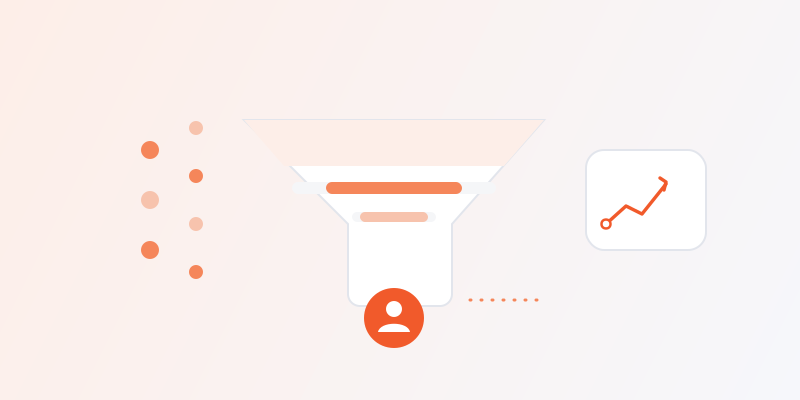
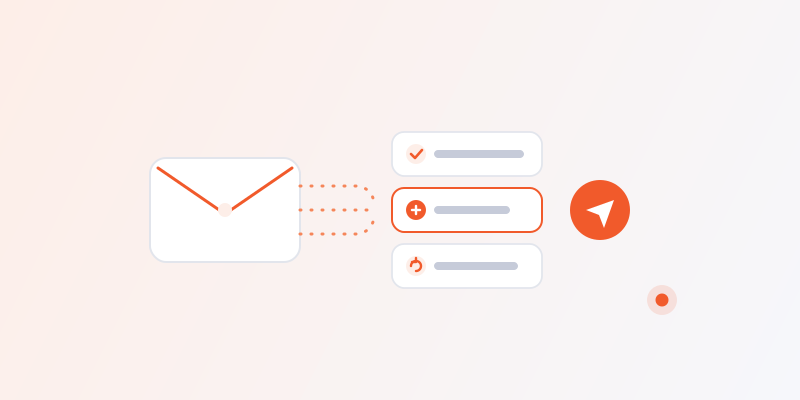
A flow is an automated sequence triggered by behaviour. Someone subscribes, abandons a cart, makes a purchase, or goes quiet, and the right emails go out on their own. You build it once and it runs indefinitely, reaching each person at the perfect moment for them, not for you.
The difference in leverage is enormous. A campaign is a fresh push every time. A flow is a machine you switch on once. Both belong in a healthy email programme, but if you only have time to build one thing, build flows, because they combine automation with timing, and timing is most of what makes an email convert.
The core flows every business needs
Six flows cover the vast majority of businesses. Here they are at a glance, then the detail on each, because the trigger, the purpose and the impact matter more than the name.
| Flow | Trigger | Goal | When to set it up |
|---|---|---|---|
| Welcome | Someone joins your list | Introduce, build trust, make a first offer | First. Every business, every time. |
| Abandoned cart / browse | Adds to cart or views a product, then leaves | Recover the near-miss sale | Early, once you have product or checkout traffic |
| Post-purchase / onboarding | Buys or becomes a client | Turn a one-time buyer into a repeat one | Right after welcome, once you have customers |
| Lead nurture | Joins but isn’t ready to buy | Stay useful until they’re ready | When leads have a longer decision cycle |
| Win-back | Goes quiet for a set period | Re-activate before you lose them | Once your list has lapsed contacts to revive |
| Review / referral | Completes a purchase or job | Turn happy customers into proof and new leads | After post-purchase, once delivery is solid |
The welcome flow (start here)
Trigger: someone joins your list. Goal: greet them, tell your story, set expectations, and make a first offer while attention is at its peak.
When someone subscribes, they’re the most interested in you they’ll ever be. The welcome flow meets that moment: a warm hello, a bit of your story, what to expect from you, and a reason to take a first action while the interest is hot. Across almost every business that measures it, the welcome flow earns more than any other single automation, often by a wide margin. It’s also the one most businesses either skip entirely or reduce to a single dull confirmation email. If you build one flow this month, build this.
Abandoned cart or browse
Trigger: someone adds to cart or views a product, then leaves without buying. Goal: recover a sale that was seconds from happening.
They were right there. An abandoned-cart flow nudges them back with a reminder, an answer to the objection that probably stopped them, and sometimes a small incentive. A browse-abandonment version does the same for people who looked but never added to cart. For service businesses, the equivalent is an abandoned-enquiry flow: someone started your contact form or booking and stopped. These flows recover sales you’d otherwise never see, entirely on autopilot, and because the intent was already high, they convert unusually well for the effort involved.
Post-purchase or onboarding
Trigger: someone buys or becomes a client. Goal: turn a one-time transaction into a lasting relationship.
The sale isn’t the finish line, it’s the start of the relationship that drives repeat revenue. A post-purchase flow confirms the order, sets expectations, tells them how to get the most from what they bought, and gently opens the door to the next purchase. For service businesses, an onboarding sequence makes new clients feel looked after from day one, which protects the relationship you worked hard to win and quietly reduces churn. Repeat customers are cheaper than new ones, and this flow is how you manufacture more of them.
Lead nurture
Trigger: someone joins your list but isn’t ready to buy yet. Goal: stay useful and top of mind until they are.
Not everyone who signs up is ready to purchase, especially for higher-priced or considered purchases. A lead-nurture flow keeps you present with helpful, low-pressure content that builds trust over days or weeks, so that when the moment to buy arrives, you’re the obvious choice. This is where longer sales cycles are won or lost. Service and B2B businesses in particular tend to leave the most money on the table here, because they treat a not-yet from a lead as a no, when it’s really a not-right-now.
Win-back
Trigger: a subscriber or customer goes quiet for a set period. Goal: re-activate them before you lose them for good.
Every list accumulates people who used to open, click and buy, and then drifted off. A win-back flow reaches out to the quiet ones with a reason to come back: a check-in, a reminder of what they’re missing, sometimes an offer. Re-activating an existing contact is far cheaper than acquiring a stranger, and this flow does it while you sleep. It also keeps your list healthy, because contacts who never re-engage can be cleanly retired instead of dragging down your deliverability.
Review and referral
Trigger: someone completes a purchase or a job is delivered. Goal: turn a happy customer into public proof and a source of new customers.
Reviews and referrals are among the highest-value assets a business has, and asking for them manually almost never happens consistently. A flow that fires at the right moment (just after a positive experience) asks for a review, and a step later invites a referral. It compounds your reputation and brings in warm leads without anyone having to remember to ask. This is the flow most businesses forget entirely, which is exactly why it’s such an easy edge.
How much revenue automated flows can drive
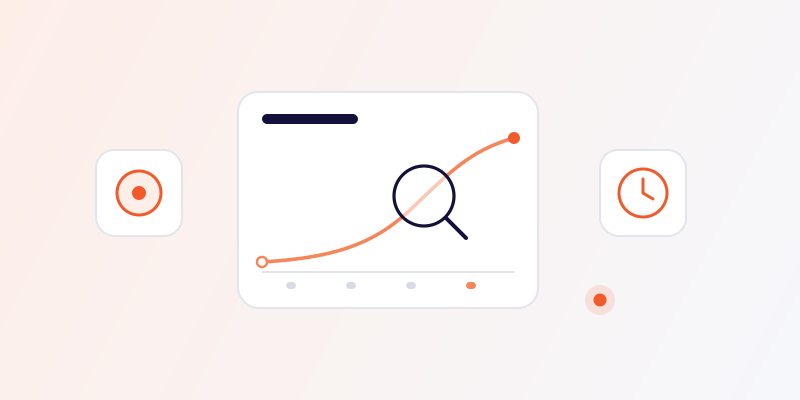
Here’s the honest version, without invented numbers. For most businesses that run both flows and campaigns, a small handful of automated flows generate a large share of total email revenue, frequently the majority, despite being a fraction of the emails sent. The reason isn’t magic, it’s leverage. Three things stack up in a flow’s favour:
- Timing. A flow fires at the moment of peak intent (just subscribed, just abandoned, just bought), not whenever you happened to schedule a send.
- Relevance. It’s triggered by what the person actually did, so the message always fits their situation.
- Automation. It runs whether or not anyone on your team hits send this week, so it never stops earning.
Put differently: a campaign competes for attention in a crowded inbox on a random Tuesday. A flow arrives exactly when the reader is already thinking about you. That’s why, per email sent, flows routinely out-earn broadcasts by a wide margin. The exact split depends on your business, your list and your offers, so treat any single percentage you read online as illustrative, not a quote. The pattern, though, is remarkably consistent: the automated minority of your emails tends to earn the majority of your email revenue. Which is the whole argument for building flows first.
Follow-up is the third job in getting more customers online, after traffic and conversion, and it’s usually the one businesses neglect while pouring money into the first two.
The tools to build them
You don’t need exotic software to run flows. Any capable email platform (an ESP) can build them. The common choices split roughly by business type:
- Ecommerce: platforms like Klaviyo or Omnisend are built around cart and purchase data, which makes cart, browse and post-purchase flows straightforward.
- General and service businesses: tools like Mailchimp, ActiveCampaign, MailerLite or Brevo handle welcome, nurture and win-back flows well and cost less at smaller list sizes.
- B2B and sales-led businesses: your flows often live inside or alongside the CRM itself, so the pipeline and the email talk to each other.
The tool matters less than what feeds it. A flow is only as smart as the data behind the trigger, which is why flows get dramatically more powerful when they connect into a CRM and the rest of your automation. When your CRM knows where each contact sits in the pipeline, your flows can react to it, sending one message to a warm lead and a different one to a cold one. And with broader automation and CRM wiring, a flow can fire from any event in your business (a form, a booking, a payment, a support ticket), not just an email signup. If you’re weighing what a CRM foundation costs to stand up, here’s a plain breakdown.
Flows are also just one species of automation. The same build-once-earn-forever logic runs your whole operation, from lead response to invoice chasing: see the automations every business should set up.
Common mistakes
The flows themselves are simple. The way businesses undermine them is predictable:
- Only sending campaigns. By far the most common miss. Businesses grind out newsletters while the flows that would earn more sit unbuilt.
- A one-email welcome. A single confirmation isn’t a welcome flow. The earnings come from a short sequence, not one lonely email.
- Set and never checked. Flows run forever, which means a broken link, an out-of-date offer or a wrong price can run forever too. Review them on a schedule.
- No segmentation. Sending every subscriber the identical message wastes the one advantage flows have, which is relevance. Even light segmentation lifts results.
- Discounting by reflex. Leading every cart or win-back flow with a coupon trains people to wait for one and quietly erodes margin. Lead with the reminder and the reason to buy, and hold the incentive back.
- A great flow pointed at a weak destination. If your emails send people to a cluttered homepage instead of a focused page, the flow does its job and the page loses the sale. Where your links land matters as much as the email: landing page vs homepage covers why.
- Forgetting the list has to be filled. Flows only run on people who join, so your traffic and funnels feed everything. A flow with no subscribers is a machine with nothing to run on.
What order to build them in
You don’t build all six at once. Build in the order that earns fastest:
- Welcome flow. Highest earner, every business, no exceptions. Start here.
- Abandoned cart, browse or enquiry. Recovers near-miss sales from traffic you already have.
- Post-purchase or onboarding. Starts the repeat-revenue engine as soon as you have customers.
- Win-back. Worth building once your list is big enough to have lapsed contacts to revive.
- Lead nurture. Especially important if your sales cycle is long or your price is considered.
- Review and referral. Layer on once delivery is solid, to compound reputation and warm leads.
The principle is simple: build the flows tied to the most immediate money first (welcome and abandonment), then the ones that extend the relationship (post-purchase, win-back, nurture), then the ones that multiply it (review and referral). Get each one live and earning before moving to the next, rather than half-building all six.
The bottom line
Don’t start email by committing to a newsletter you’ll abandon in a month. Start with flows: welcome, abandoned cart or enquiry, post-purchase or onboarding, lead nurture, win-back, and review or referral. Build them once and they capture sales, rescue abandoned carts, revive quiet customers and turn happy ones into proof, automatically, at the exact moments that matter most. It’s the highest-leverage work in email, which is precisely why it should come first.
Set up well, email marketing services stop being another newsletter to write and become a machine that follows up perfectly, every time, without you lifting a finger. Want these built and wired into the rest of your marketing by one connected team, instead of stitching together an email tool, a CRM and three freelancers who never talk? Book a call and we’ll map the flows that will quietly make you money, or see pricing to check the flat monthly fee first.