Quick answer
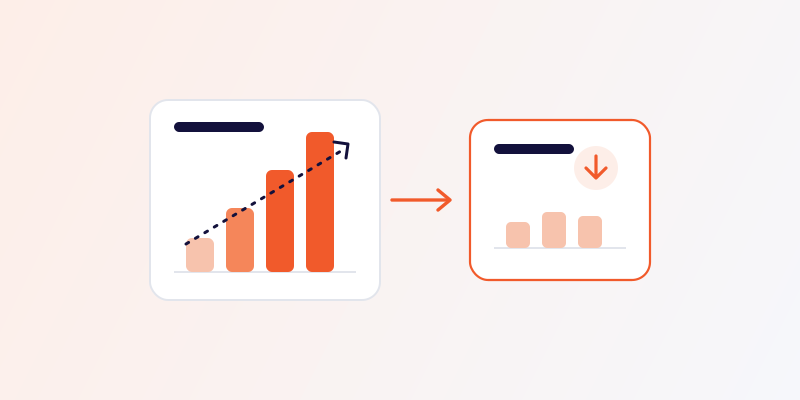
Zapier gets expensive because it charges per task, so multi-step automations at volume burn through your quota fast. First cut the bill: consolidate steps, add filters so Zaps only run when they should, and slow down how often they check for new data. If it still hurts, move the heaviest workflows to Make (cheaper per action, more power) or n8n (cheapest at scale, more technical), and consider custom automation once the logic outgrows any off-the-shelf tool. Migrate the expensive Zaps first and leave the cheap, simple ones where they are.
Zapier is brilliant at getting you started. It is also brilliant at quietly growing your monthly bill until, one day, you open the invoice and wonder how automating a handful of things costs this much. That is not a bug, it is the pricing model doing exactly what it is designed to do. The good news is that a climbing Zapier bill almost always has two fixes, and most people reach for the expensive one first: you can cut the bill you already have, and you can move the heaviest work to a cheaper tool when the numbers stop making sense. Here is why the bill climbs, how to bring it down fast, and when it is worth switching to Make, n8n, or custom automation, without breaking the workflows you rely on.
Key takeaways
- Zapier charges per task, and a task is every action step, so a five-step Zap costs five times a one-step Zap at the same volume.
- Before switching, you can often trim the bill (30 to 60 percent is common, illustrative and not a quote) by consolidating steps, adding filters, and slowing how often Zaps check for new data.
- Switch tools when the bill outpaces the value, you are rationing automations to stay under a limit, or you keep hitting logic walls Zapier handles awkwardly.
- Make suits most businesses (cheaper per action, more power, a modest learning curve). n8n is cheapest at scale, especially self-hosted, but more technical.
- Custom automation earns its place when the logic outgrows any off-the-shelf tool, or a workflow is core enough to own outright.
- The real hidden cost is not the subscription. It is your time, the automations that break silently, and nobody actually owning the system.
The quick answer
- Why it gets expensive: Zapier charges per task (every action step), so multi-step automations at volume burn through your quota fast.
- Cut it first: consolidate steps, add filters, reduce polling, and use built-in tools before you pay for a higher tier.
- When to switch: when the bill outpaces the value, you’re rationing automations to stay under a limit, or you need more logic than Zapier handles cleanly.
- What to switch to: Make (cheaper per action, more powerful), n8n (cheapest at scale, more technical), or custom automation for core, complex workflows.
Why your Zapier bill keeps climbing
The whole thing comes down to how Zapier counts usage. Once you understand the counting, the invoice stops being a mystery and starts being something you can control.
How task-based pricing works
Zapier charges per task, and a task is a single action step that a Zap performs. The trigger is usually free. Every action after it, sending an email, creating a row, updating a contact, counts as one task each time it runs.
So the cost of any automation is not “one Zap.” It is the number of action steps multiplied by how many times the Zap runs. A one-step Zap that runs 1,000 times a month uses 1,000 tasks, which feels cheap. The trouble starts when automations get longer and run more often.
Multi-step Zaps multiply the count
Real automations are rarely one step. A useful workflow might grab a new lead, look them up, add them to your CRM, tag them, send a welcome email, and notify your team. That is five or six action steps, and every run charges you for all of them.
- A 2-step Zap that runs 500 times a month is 1,000 tasks.
- A 6-step Zap that runs 2,000 times a month is 12,000 tasks.
As you automate more of the business, and as your automations get more sophisticated, your task count does not grow in a straight line. It compounds, because more automations, more steps, and more runs all pile on at once.
Polling frequency and plan tiers push it further
Two more things quietly raise the bill. First, polling: many Zapier triggers do not fire the instant something happens but check your apps on a schedule, and faster schedules sit on higher plans, so wanting near-instant automation nudges you toward pricier tiers. Second, the tiers: task limits come bundled into fixed monthly plans, so crossing a limit does not cost a few cents extra. It bumps you up a whole tier, and the bill jumps in steps rather than smoothly.
Put together, here is what actually drives the number on your invoice.
| Driver | What it means | Why it inflates the bill |
|---|---|---|
| Task-based pricing | You pay for every action step a Zap runs, not per Zap or per automation | Cost scales with volume times steps, not with how many automations you have |
| Multi-step Zaps | Each extra step is another task every time the Zap runs | A five-step Zap costs five times a one-step Zap at the same run volume |
| Polling frequency | Zapier checks apps for new data on a schedule, and faster checks sit on higher plans | Wanting near-instant automations pushes you into pricier tiers |
| Plan tiers | Task limits are bundled into fixed monthly tiers | Crossing a limit forces a whole tier upgrade, so the bill jumps in steps |
None of this makes Zapier bad. It makes it a tool you can outgrow.
The signs you’ve outgrown it
You are probably past cutting the bill and closer to switching if:
- You’re rationing automations to stay under a task limit, or deleting useful Zaps to save quota, when automation should be removing work rather than making you choose which work to leave manual.
- The bill has climbed into “wait, really?” territory relative to what you are getting back.
- You keep hitting a wall on logic: branching, loops, or data handling that Zapier makes awkward or forces you to fake with extra steps.
- You’re on a top tier and still constrained. That is the clearest signal of all. There is no higher plan to solve it, only a different tool.
If a couple of simple Zaps are costing very little, ignore all of this and carry on. The switch only makes sense once the numbers hurt, and even then there is usually money to save first.
How to cut your Zapier bill without losing automations
Most people jump straight to switching tools. Try this first: it is faster, keeps everything in place, and often buys a lot of runway. The goal is simple, run fewer tasks for the same result.
Consolidate steps
Look for steps that exist out of habit rather than need: formatting you could handle inside another action, lookups you repeat, notifications that fire when nothing important happened. If two Zaps trigger on the same event, folding them into one removes a duplicate trigger and shared setup. Fewer steps per run means fewer tasks per run, every time.
Add filters so Zaps only run when needed
This is the single biggest lever most people miss. A Zap that runs on every new record, then decides halfway through it had nothing to do, still charged you for the steps it ran to figure that out. Add a filter early so the Zap stops before it spends tasks: only route leads above a certain value, only email new contacts, only sync records that actually changed. A filter step is cheap. The tasks it prevents are not.
Reduce polling frequency
Not everything needs to happen within seconds. If a report can build hourly instead of every few minutes, or a sync can run a few times a day instead of constantly, slow it down. Fewer runs means fewer tasks. Reserve the near-instant automations for where speed genuinely matters, like a hot lead hitting your inbox.
Use built-in tools and Paths
Zapier has built-in utilities for formatting, filtering, delaying, and branching. Using Paths to split logic inside one Zap is usually cheaper and cleaner than running several near-duplicate Zaps side by side, and leaning on them instead of extra app calls keeps your step count down. For a sense of which automations are worth keeping, our guide to the automations every business should set up is a good gut check.
Do these four things and it is common to recover a large slice of your task quota (30 to 60 percent is a realistic range, illustrative and not a quote) without losing a single automation. If the bill is still painful after that, the switch is worth it.
When to switch to Make or n8n
Once you have trimmed the fat and the numbers still do not work, moving your heaviest workflows to a cheaper tool is the right call. Both cost far less than Zapier at volume, in different ways. For the full three-way breakdown, see Make vs Zapier vs n8n.
Make: the value sweet spot
Make (formerly Integromat) charges per operation at a much lower unit price than Zapier’s per-task model, and gives you a visual builder with real logic: branches, loops, and proper data handling. For most businesses leaving Zapier, this is the natural next home: big savings and more power for a modest learning curve, no engineering team required. If you have outgrown a handful of simple Zaps but are not ready to run your own servers, Make is usually where you land.
n8n: cheapest at scale, most technical
n8n charges per execution (one whole workflow run, no matter how many steps), or nothing at all if you self-host the open-source version. That makes it the cheapest option at high volume and the most flexible for complex, developer-grade logic. The trade-off is that it is the most technical to set up and maintain, and self-hosting means someone owns the infrastructure. It shines in two cases: very high volume where per-task pricing would be brutal, and data-sensitive work you want kept on your own infrastructure.
Here is how the options compare on the two things that matter most, how they charge and who they suit.
| Tool | Cost shape | Best for |
|---|---|---|
| Zapier | Per task (every action step), bundled into fixed tiers | Non-technical teams, fast starts, low volume, the widest app library |
| Make | Per operation at a much lower unit price | Most growing businesses wanting more power at a fraction of the cost |
| n8n | Per execution, or effectively nothing self-hosted | High volume, complex logic, or data you want on your own infrastructure |
| Custom automation | One-time build plus hosting, no per-task fee | Core workflows, deep integrations, and logic no off-the-shelf tool handles cleanly |
A rough rule: Make if you want the best cost-to-effort balance, n8n if raw volume or control matters most and you have technical help.
When to move to custom automation
Custom automation, code that runs a workflow directly rather than a no-code canvas wiring apps together, becomes the better answer when:
- The logic has outgrown every off-the-shelf tool. You are stacking so many branches, lookups, and workarounds that the visual builder is now harder to read than plain code would be.
- The workflow is core to your business. If an automation is central to how you make money, owning it outright, with no per-task meter and no vendor pricing change hanging over it, is often worth the build.
- You need deep, reliable integrations. Custom code can reach internal systems and APIs the connectors never quite touch, and handle errors your way.
- Volume is high and predictable. At real scale, a one-time build plus modest hosting can undercut any per-run pricing, and the cost stops climbing.
Custom is not the default and it is not the goal. Most businesses are best served by Make or n8n for a long time. But when a workflow is important and complex enough, building it properly is the honest answer. If you are weighing this against a no-code approach, our take on no-code vs custom development covers the trade-off.
The hidden cost of DIY automation
Whichever tool you land on, there is a cost that never shows up on any invoice, and it is usually bigger than the subscription: doing all of this yourself.
Your time
Every hour spent learning a tool’s quirks, rebuilding Zaps, and debugging a broken step is an hour not spent on the work only you can do. Automation is supposed to give time back, not quietly take your evenings in maintenance.
Silent breakage
Automations rarely fail loudly. An app changes an API, a login expires, a field gets renamed, and the workflow just stops, often without an alert. You find out weeks later when a customer asks why they never got the email, or a report has sat empty. The damage is not the fix. It is everything that did not happen while it was broken.
Nobody owns it
The most expensive pattern is the automation that “sort of works” and that nobody owns. One person set it up, then left or got busy, and now everyone is a little afraid to touch it. It limps along, half-trusted, until it breaks badly enough to force a scramble. Automation without an owner is a liability dressed up as an asset.
This is where one connected team on a flat monthly retainer changes the math. The build, the monitoring, and the fixes all sit with the same people, instead of you juggling subscriptions, your own time, and a workflow nobody owns. That is part of the wider case for a productized agency: predictable cost, a clear owner, and no scramble when something breaks.
An illustrative scenario
Here is how it plays out, with illustrative numbers, not a quote.
Picture a growing business running its lead handling on Zapier. A new form submission triggers a six-step Zap: format the data, look up the contact, add them to the CRM, tag them, send a welcome email, and ping the sales channel. It runs about 2,500 times a month, so that is roughly 15,000 tasks from one workflow, enough to push them onto a higher plan.
Step one, cut the bill. A filter stops the Zap early on obvious junk submissions, two formatting steps get folded into other actions, and polling on a couple of secondary syncs slows to hourly. The task count drops enough to fall back under a lower tier, with no automation lost and no new tool involved.
Step two, move the heavy hitter. As volume keeps growing, the lead workflow gets rebuilt in Make, where the same six steps cost a fraction per run. The simple, low-volume Zaps stay on Zapier because moving them would save pennies and cost effort. The result is a smaller, more predictable bill, reached by cutting first and switching second.
How to switch without breaking things
Migrating means rebuilding your automations in the new tool, since there is no magic import button. It is straightforward if you are smart about the order.
- Start with the expensive ones. Rebuild the Zaps eating the most tasks first. The savings start immediately, and you learn the new tool on the work that matters most.
- Leave the cheap, simple ones alone until later, or forever. A handful of low-volume Zaps costing very little are fine where they are.
- Test in parallel before you switch off Zapier, so nothing critical goes dark. Run the old and new versions side by side until you trust the new one.
- Document what each automation does as you go. Knowing the trigger, the steps, and why each exists is valuable whichever tool runs it, and it is how you avoid the “nobody owns it” trap.
Done in that order, you capture most of the savings quickly while keeping the disruption tiny.
The bottom line
Zapier is not ripping you off. You have simply outgrown its pricing model, which is perfect when you are small and punishing when you scale. Before switching, cut the bill you have: consolidate steps, add filters, reduce polling, use the built-in tools. If it still hurts, move the heavy workflows to Make (best value for most), n8n (cheapest at scale, more technical), or custom automation when a workflow is core and complex enough to own. Migrate the expensive automations first, test in parallel, and keep the simple stuff wherever it is cheapest.
Want someone to audit your Zapier bill, tell you exactly what to cut, what to move, and what to rebuild, all handled by one connected team for a flat monthly fee? That is what our workflow automation services are for. Book a call and we will turn a scary invoice into a system that scales, or see pricing first.